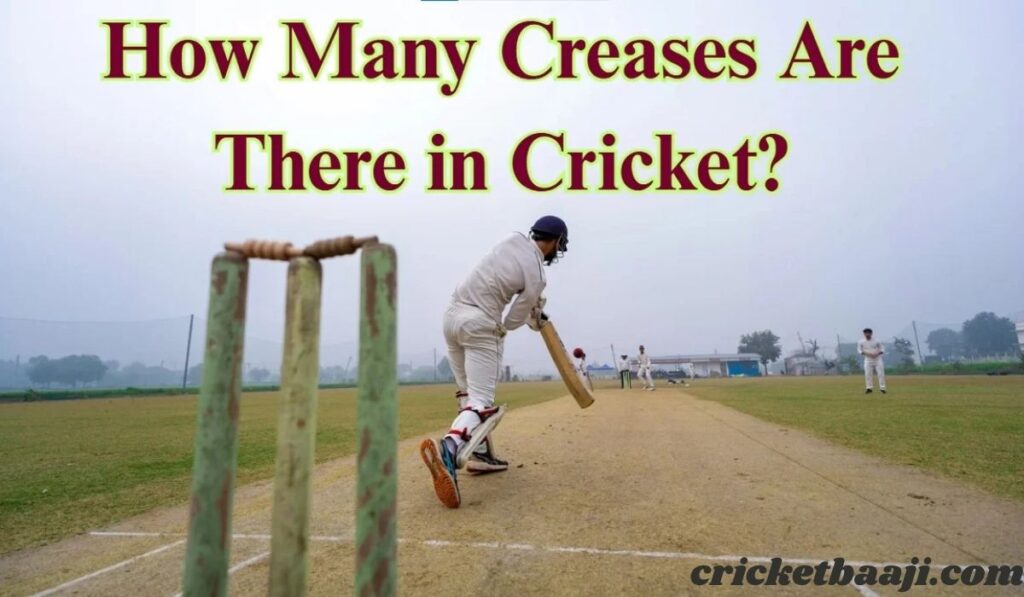

Cricket is a sport consisting of rules, measurements and markings galore, and one of the most significant markings on any pitch is the crease. If you want to know what a run-out, a no-ball, stumping or bowled decision is, the Explanation must begin with the Crease. It’s a question many new followers wonder: how many lines are in cricket?
In this full-fledged article, you will come to know about Crest lines the number of creases, Types, function, Size and Significance in very easy language.
What Are Creases in Cricket?
Lines Crickets lines are white markings on the pitch/court. These lines assist batters and bowlers alike, and help umpires make the right calls. Every vital decision of no-ball, run-out, stumping and fair delivery is dependent on the crease.
They are an intrinsic component of a 22-yard pitch.
How Many Creases Are There in Cricket? (Correct Answer)
On each end of the pitch there will be 4 creases.
So in total, there are:
✔ 8: creases in cricket on the entire pitch
But while we talk about the forms of creases, there are three basic kind of crease:
- Bowling Crease
- Popping Crease
- Return Crease
These three types are present on both ends, making a total of 6 functional creases, but 8 lines overall.
Types of Creases in Cricket (With Simple Meaning)
Here are all 3 creases explained in detail with measurement and purpose.
1. Bowling Crease
The other crease is the bowling crease where the stumps are placed.
Key Details
- Stretch out: 8’8″ (2.64 m).
- There are three stumps in the line of this row.
- The ball must be bowled from a point behind this line.
Purpose of Bowling Crease
- Indicates the location of the wicket.
- Applied to assess bowled, hit-wicket and wicket decisions.
- Helps to mark where the bowler needs to be standing.
2. Popping Crease
Popping crease is the most widely used crease in batting.
Key Details
- It is 4 feet (1.22 metres) in front of the bowling crease.
- The edge is at least 6 feet (1.83 metres) out on both sides from the return creases.
Purpose of Popping Crease
- This is a crease for the Batter to run into so that they are not out by being stumped or run out.
- Wicketkeeper also uses it for stumping decisions!
- Also applied to front-foot no-balls.
- Aid in deciding if batter has “made the ground”
3. Return Crease
The return crease is drawn at right angles to the bowling crease, such that it extends from one side of the pitch to the other.
Key Details
- Long: 8 feet (2.44 meters) or longer.
- It stretches above and below the bowling crease.
Purpose of Return Crease
- Specifies the legal area for bowler’s back foot.
- It is a no-ball if the bowler’s back foot lands beyond the return crease.
- Stops the bowlers bowling unfair wides.
Types of Creases in Cricket
| Crease Type | Measurement | Purpose |
|---|---|---|
| Bowling Crease | 8 ft 8 in (2.64 m) | Stumps positioned here; wicket area |
| Popping Crease | 4 ft (1.22 m) in front of bowling crease | Run-out, stumping, no-ball, batter safety |
| Return Crease | 8 ft (2.44 m) vertical lines | Controls bowler foot placement; back-foot no-ball |
Why Are Creases Important in Cricket?
Creases keep the game true and assist umpires in making good decisions.
✔ For Batters
- At no point may they go in front of the popping crease to prevent run-out.
- Teaches them about the safe zone.
✔ For Bowlers
- need to release from behind return crease.
- Shall not advance their front foot beyond the popping crease.
✔ For Umpires
- Creases help judge:
- No-ball
- Stumping
- Run-out
- Hit-wicket
- Fair delivery
- Overstepping
Difference Between Bowling Crease and Popping Crease
| Bowling Crease | Popping Crease |
|---|---|
| Stumps stand on this line | Located 4 ft in front of the bowling crease |
| Used to judge bowled/wicket area | Used to judge run-out, stumping, no-ball |
| Important for bowler’s delivery area | Important for batter safety |
How Creases Apply in Different Dismissals
1. Run-Out
The batsman must ground his bat behind the popping crease before the ball hits the stumps.
2. Stumping
If not and the batter has wandered from the popping crease in playing or missing a delivery, he can be stumped.
3. Bowled
Ball hits the stumps over bowling crease.
4. Hit-Wicket
If the batter disturb the stumps while on bowling crease after the ball is bowled.
5. No-Ball
- He’s in good nick” Youngs would announce, optimistic that England was on its way to ameliorating the humiliation they had suffered at their hands a week earlier.
Or the back foot crosses the return crease
All Crease Measurements in One Table
| Crease Type | Distance / Size |
|---|---|
| Bowling Crease | 2.64 m (8 ft 8 in) |
| Popping Crease | 1.22 m (4 ft) from the bowling crease |
| Return Crease | Minimum 2.44 m (8 ft) vertical |
Final Answer: How Many Creases Are There in Cricket?
To summarise:
✔ There are 4 folds at each ends of the pitch
✔ That’s 8 folds all together
✔ Cricket – Three Sets of Stumps: There are 3 types of sets of
- Bowling Crease
- Popping Crease
- Return Crease
All of these shoot vital deliveries in bowling, batting and umpiring decisions.
So that’s full knowledge of creases in cricket!
Read More: Ravindra Jadeja Jersey Number / Mohammed Shami Profile – Age, Career Info & Stats
Conclusion
Creases are the soul of cricket, because fairness, player-boundaries and decision-making are all based on it. Knowing how many folds are there in cricket helps every fan understand the game even better. Featuring well defined dimensions and purposes, these lines help to ensure orderliness and uniformity in each game played.
If you are a new beginner to the game, or even if you love it and know much about it, understanding the bowling crease, the popping crease and return creases will give you an insight of how cricket is played.
FAQs About How Many Creases Are There in Cricket?
1. How many wrinkles are in a cricket?
A. There is a crease at either end of the pitch, so in total there are eight creases. Yet, there are 3 primary kinds of creases: bowling crease, popping crease, and return crease.
2. What are the 3 types of creases in cricket?
A. The three types of creases are:
Bowling Crease
Popping Crease
Return Crease
3. why popping crease is used?
A. Run-out, stumping and no-ball decisions are made on the popping crease. A batter has to make it to this crease in order to be declared “safe.”
4. What is the difference between the bowling crease and popping crease?
A. The stumps are situated at the bowling crease.
The safety line 4 feet in front of the bowling crease is called popping crease.
When the Popping Crease saves the Batsman, it is mainly used by the bowlers, Whereas Bowlers concentrate either on Bowling crease.
5. How far away is the popping crease from there stumps?
A. The popping crease lies 4 feet (1.22 metres) in front of the stumps on the bowling crease.
6. What is the purpose/benefit of return crease?
A. The return crease leads the bowler’s rear foot. Bowler’s back foot crossing the return crease at delivery (it is a no-ball).